
TWO PERCENT GOAL TO FINANCIAL INDEPENDENCE


Al O’Grady
Hi, my name is Al O’Grady, and I am the founder of Two Percent Goal to Financial Independence. With a degree in Economics and over fifteen years of experience in financial services, including completing the Canadian Securities Course, I’ve learned what works and what doesn’t in the financial world. This experience has made me a wiser investor, helping me achieve my goals in life.
My Ultimate Goal
My goal is to double my money on the stock market each year with little to no risk. That may sound crazy, but I feel I have the strategy to do it in bull and bear markets.
I am not a day trader. This is not a day trading strategy. I am a swing trader. What’s the difference? A day trader buys and sells his or her position within the same day. He does not own a stock before the market opens and he has closed out his position before the market closes.
A swing trader has a longer time horizon. He holds his position between a couple of days to a couple of weeks. I hold 95% of my recommendations from 3 days to 2 weeks and most of my picks are held for one week.
This is not flashy, it’s not sexy, it’s boring and it’s very effective. In order to double your money, you need to generate a 100% return. That’s an approximate average of 2% per week. That’s my goal. Find stocks that are poised to gain 2% in one week. Get in, get out, move on and repeat.
That’s the goal, what’s the plan?
Yes, I want to receive daily emails with your stock picks poised for a 2% gain. It’s free for 30 days and then $49/month.
My Plan
Here is what I do. The most important thing is to follow EVERY rule. By doing this you take emotion out of it, and you don’t get caught up in the hype when the stock is climbing or play the hope game when the stock declines. Here are my ten rules:
Rule #1
Invest only in the 500 largest cap stocks on the New York Stock Exchange aka the S&P 500.
You should only be looking at companies within the S&P 500. These are companies you know. They are well established companies making real products and real profits. These are companies like Home Depot, Pfizer, Exxon, Johnson & Johnson etc. What is also very important about trading these companies is that they are all widely traded and it is very easy to enter and exit a position.
Rule #2
Look for an oversold Relative Strength Index (RSI) and rising out of the oversold range
Look at the company’s Relative Strength Index (RSI). You want to watch stocks that are oversold. Remember, BUY LOW. Once the RSI was in the oversold range and is coming out of it (rising above the 30 level), it is getting ready to climb. This is your first signal, but other conditions must be met.
Rule #3
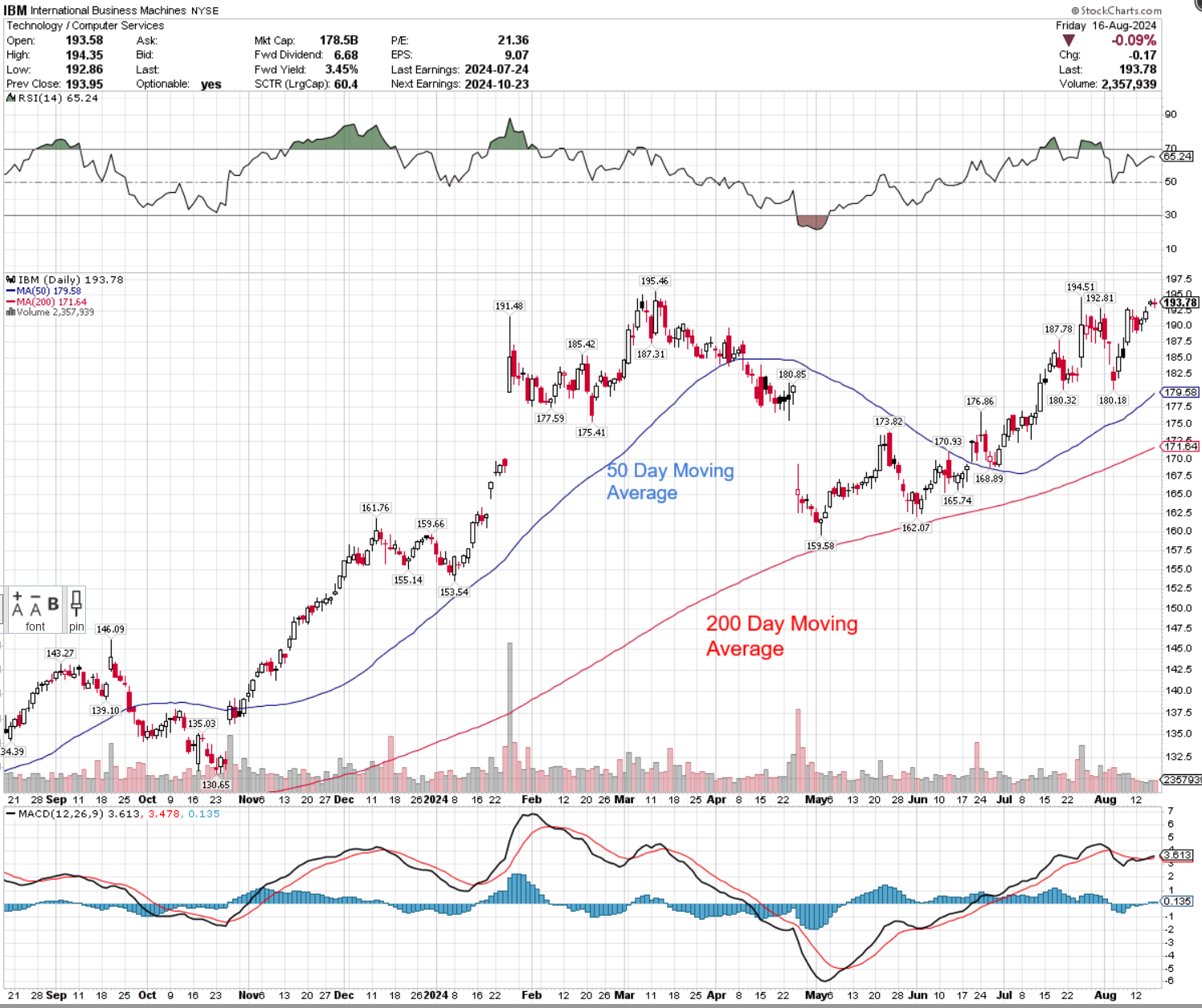
When buying a stock, the 50-day average MUST be above the 200-day average
The RSI tells you if the stock is oversold (or overbought), but you always want to trade with the trend. Go with the flow. When buying a stock, you want the 50-day average to be above the 200-day average. NO EXCEPTIONS. When this happens, the overall trend is positive. When identifying a stock that is oversold with the RSI and the 50-day average is above the 200-day average, you have a great 1-2 punch. Put this stock on your daily watch list, BUT DO NOT BUY IT YET. The following conditions MUST also be met.
Rule #4
BUY SIGNAL: The Stochastic Oscillator
At this point you have a stock in your watch list . You should watch it daily. The RSI shows it was oversold and you want to buy low for value. The 50-day average is above the 200-day average so overall the stock is bullish. When do you pull the trigger? The most important signal at this point is the stochastic oscillator. Similar to the RSI it shows stocks that are overbought or oversold but the RSI can give a false signal or be a few days too early. Look for the stochastic oscillator to be in oversold territory (below 20) and penetrating past the 20 mark. This is the time to buy, but you need further confirmation from two other sources.
Rule #5
Confirmation Signal #1: The On-Balance Volume
-
-
-
You have identified a stock that is oversold with the RSI; it is in a bullish trend with the 50-day/200-day averages and you are ready to pull the trigger with the stochastic oscillator but get further confirmation. Start with the on-balance volume (OBV). The OBV keeps a running total of volume depending on price action of the stock. When the stock has an up day, the total daily volume is added. When the stock has a down day, the total daily volume is subtracted. The actual number is immaterial. What is important is the trend. When you have strong volume on days where the price has risen, this is a positive sign. Use the OBV as confirmation. When the stochastic oscillator penetrates the 20 line, ONLY BUY if the OBV has an uptick day or is in an overall uptrend. If not, DO NOT buy until the OBV does confirm.
Rule #6
Confirmation Signal #2: The MACD
The final confirmation you need before entering the trade is the MACD or moving average convergence divergence. The MACD is an exponential moving average of the stock price. It has two lines, one red, one black. The black line is a faster moving average than the red line and is therefore more volatile. Your final confirmation point is to ensure the black MACD line is moving up. If it is going sideways or down, DO NOT buy the stock. Quite often the entry point is at the trough of the MACD and the black line may be just starting to change direction That’s ok so long as it starting to move up, otherwise do not buy the stock until the MACD confirms.

Rule #7
Use Limit Orders Not Market Orders
In order to maximize profit and minimize loss, your entry point is crucial. When you choose to buy a stock make sure it is a limit order and not a market order. A market order fills your order at the going market price while a limit order is a market order up to your limit. For example if want to buy a stock at $100 a share and you place your order before the market opens and the market opens with the stock listed at $110 a share, your order would be filled at $110 per share. I suggest using a limit order that is 1% above the closing price. So if the market closes at $100 and you place your limit order at $101, if the market opens at $110 a share your order would not be filled. If you cannot get your order filled at the price you want, move on. There is always another buying opportunity.
Rule #8
Use Stop Losses to Minimize Losses and to Maximize Gains
- Our ultimate goal is to double our money each year. We break that down into smaller bites by aiming for a 2% return per week by swing trading. No method is 100% guaranteed. There will be times when we are wrong. In order to protect yourself, after buying the stock, immediately put in a stop loss that is 3% below the settlement price. If you buy a stock at $100, your stop loss should be set at $97. This will minimize losses for those times the stock did not do what we thought it would.
- Use stop losses to maximize gains as well. By using stop losses you can also ride the wave and make more than your 2% goal. Again, let’s say you entered a trade at $100. Your goal is $102. Let’s say in three days the stock surpassed your 2% goal and closed at $102.75. You set your stop loss at $102 to guarantee a 2% return. Now let’s say the intra-day low price the next day only went down to $102.50. Your stop loss order was not filled. GREAT.
- Revise your stop loss to $102.49. Let’s say the stock is climbing and the next day the intra-day low was $102.75. EVEN BETTER. You revise your stop loss to $102.74. Each day you keep revising your stop loss order so that the trigger price is one penny lower than the previous intra-day low.
- You repeat this process daily. Sooner or later there will be a down day and your stop loss order will be filled. You will have taken advantage of a major upswing while still guaranteeing your minimum goal.
Rule #9
Diversify
As the saying goes, do not put all of your eggs in one basket. I strongly recommend you do not put more than 10% of your portfolio on one stock. You can diversify even more by not putting no more than 5% of your portfolio on one position but you could be watching 20 stocks at one time and that could be overwhelming for some. By diversifying, any losing positions will have a minimal impact on your entire portfolio.
Rule #10
Consider Leverage
Buying your stocks on margin will drastically increase your returns while diversity minimizes risk. If you have a $100,000 portfolio, a 10% diversity factor means you would never put more than $10,000 in one stock purchase. By using a 3% stop loss, you are risking a $300 loss. If you bought this on 3x margin, you would be risking a $900 loss. A $900 loss on a $100,000 portfolio is less than a 1% loss of the entire portfolio and certainly within guidelines for swing trading.
If buying on margin is still outside of your risk tolerances, don’t do it. Try these strategies without buying on margin until you gain confidence in the program and then ease into margin slowly.
So How Accurate is This?
From January 1, 2025 to December 31, 2025
282828
| TOTAL SUMMARY | ||||||||
| Total Number of Recommendations | 592 | |||||||
| @2% minimum | ||||||||
| Going Long Winners (Gained 2% or more) | 196 | 672.59% | ||||||
| Going Short Winners (Gained 2% or more) | 116 | 385.83% | ||||||
| 312 | subtotal | 1058.42% | ||||||
| Total Loss | ||||||||
| Going Long Losers (Gained less than 2%, lost 3% or less) | 109 | 272.80% | ||||||
| Going Short Losers (Gained less than 2%, lost 3% or less) | 121 | 289.85% | ||||||
| 230 | 562.65% | 562.65% | ||||||
| Net Gain | 495.77% | |||||||
| Total Picks | 592 | |||||||
| Net Total Average/Pick | 0.91% | |||||||
| Ratio 2% Winners to 3% Losers | 2.48:1 | |||||||
If you are a swing trader you can use my strategies to earn excellent annual returns. You can do this.
OR
I can do the research for you. I can tell you what to buy, when to buy it, when to sell it, and what your stop losses should be. Simply sign up to receive my daily emails with stock recommendations. The first 30 days are absolutely free and then it’s $49/month. If my picks do not generate a profit for the month, I will refund your $49. You can cancel at any time. This program pays for itself. Take control of your finances. Take control of your life
While the test data is overwhelmingly positive, there are risks with this type of investing and the author accepts no responsibility for any possible losses.
My 10 Essential Rules for Success
Don’t Believe a Word I Say
If you’re skeptical and think I’m full of hot air, I get it. That’s why I will give you the first 30 days FREE. If you sign up. I will send you notifications when to buy a stock that’s poised for a 2% jump. I’ll give you stop loss orders to protect yourself and when to exit a profitable trade. I will also send you my data where I have back tested the 500- large cap companies on the NYSE. You can examine this free of charge. There is no risk to you at all. You have everything to gain and nothing to lose. After your free 30-day trial, you can exit the program at any time. Take control of your future, take control of your life. Get started on the 2% goal to financial independence right now.
While the test data is overwhelmingly positive, there are risks with this type of investing and the author accepts no responsibility for any possible losses.